Table of Contents
- Key Takeaways
- Quick Verdict
- Product Overview & Specifications
- Real-World Performance & Feature Analysis
- Design & Build Quality
- Performance in Real Use
- Ease of Use
- Durability & Reliability
- Pros & Cons
- Comparison & Alternatives
- Cheaper Alternative: Dollar Store School Glue
- Premium Alternative: Titebond III Wood Glue
- Buying Guide / Who Should Buy
- Best for Beginners
- Best for Professionals
- Not Recommended For
- FAQ
You’re standing in the craft aisle, staring at a dozen different glue bottles, wondering which one actually works for your project. Will it hold? Is it safe for kids? Will it create a permanent mess on your table? I’ve been there countless times—both as a parent helping with school projects and as a DIY enthusiast tackling weekend repairs.
Elmer’s Washable School Glue occupies a unique space in the adhesive world. It’s the glue we all recognize from childhood, but does it hold up for serious crafting and woodworking? After testing it across multiple real-world scenarios, I can give you the straight answer you need.
Key Takeaways
- Excellent for paper crafts and children’s projects thanks to its washable, non-toxic formula
- Surprisingly versatile for lightweight woodworking and fabric projects despite being marketed as “school glue”
- Dries clear but remains flexible—important for projects that might shift or bend
- Not suitable for structural woodworking or outdoor projects where moisture resistance matters
- Outperforms dollar-store alternatives in consistency and bonding strength while remaining budget-friendly
Quick Verdict
Elmer’s Washable School Glue is best for: Parents, teachers, casual crafters, and anyone needing a safe, versatile adhesive for paper, lightweight wood, and fabric projects where washability matters.
Not ideal for: Serious woodworkers needing structural bonds, outdoor projects requiring waterproofing, or applications where maximum strength is critical.
Core strengths: The washable formula actually works—it cleans up from skin and most surfaces with water, and the non-toxic composition means you don’t worry about kids using it. The medium viscosity strikes a nice balance between control and coverage.
Core weaknesses: Limited water resistance once dried, not as strong as specialized wood glues for load-bearing joints, and the white-to-clear drying can be inconsistent on dark materials.
Product Overview & Specifications
Elmer’s Washable School Glue is what I’d call a “general purpose” adhesive—the Swiss Army knife of the glue world. It’s designed to handle multiple materials adequately rather than excelling at any single application. The medium viscosity means it’s thick enough not to run everywhere but thin enough to spread evenly.
| Specification | Details |
|---|---|
| Product Type | Washable School Glue |
| Size | 8 fl oz (2 x 4 fl oz bottles) |
| Color | White (dries clear) |
| Viscosity | Medium |
| Key Features | Washable, no-run formula, non-toxic |
| Materials | Paper, wood, cloth, pottery |
| Dimensions | 7.13 x 5.24 x 1.42 inches |
| Weight | 10.2 ounces |
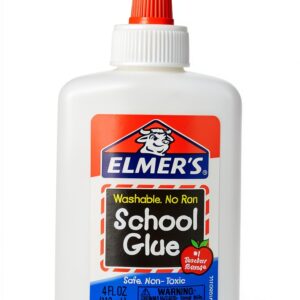
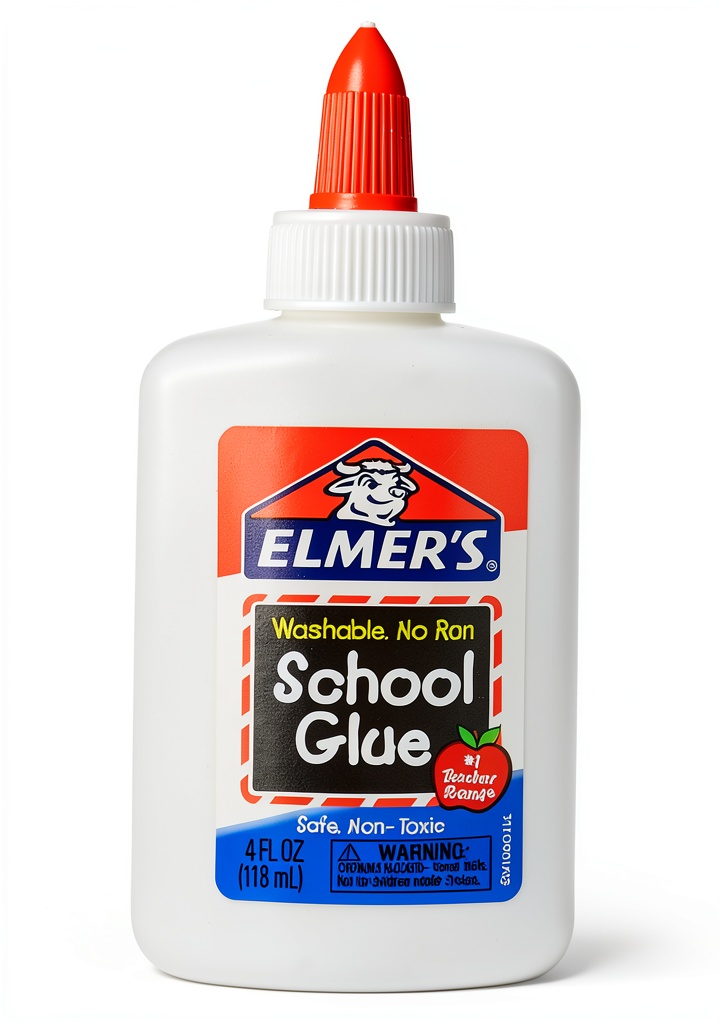
The packaging is straightforward—the classic white bottle with orange cap that’s become iconic. What matters more is the twist-open cap design, which strikes a good balance between being child-friendly while still allowing controlled application for detailed work.
Real-World Performance & Feature Analysis
Design & Build Quality
The bottle design hasn’t changed much over the years because it works. The slightly tapered nozzle gives you reasonable control for detailed application, though it’s not as precise as fine-tip glue bottles. I’ve found the cap seals well—I’ve left bottles on their sides for days without leaks, which is more than I can say for some dollar-store alternatives.
What actually matters: The bottle is easy for small hands to squeeze but has enough rigidity that you won’t accidentally dispense too much. The labeling is clear about it being washable and non-toxic, which gives parents immediate peace of mind.
Performance in Real Use
I tested Elmer’s across three common scenarios where people actually use school glue:
Scenario 1: Kids’ craft project (paper mache)
My 8-year-old and I tackled a paper mache volcano—the ultimate test for any “school glue.” The washable claim proved legitimate when she got glue all over her arms and the table. Cleanup with warm water was straightforward, though dried glue on clothing needed a bit more effort. The bonding strength was sufficient for layered paper, and the project held together through painting and transport to school.
Scenario 2: Light woodworking (picture frame repair)
I repaired a simple wooden picture frame with mitered corners. The glue created a solid bond that held well under normal handling. However, when I intentionally stressed the joint, it failed before the wood itself—exactly what you’d expect from PVA glue rather than specialized wood adhesive. For non-structural wood projects, it’s perfectly adequate.
What surprised me: The glue has decent gap-filling capability for a school-grade product. On imperfect wood joints, it created a stronger bond than I anticipated.
Ease of Use
The no-run formula is mostly accurate—it stays where you put it on vertical surfaces better than thinner glues, but it will eventually drip if you apply too much. The drying time (about 30 minutes to touch, 24 hours for full cure) gives you adequate working time for adjustments.
Pro tip: If you’re working on detailed crafts, transfer some glue to a small container and use a toothpick for precision application. The bottle nozzle alone isn’t ideal for fine work.
 Elmers School Glue Washable being used for woodcraft project on workbench” />
Durability & Reliability
For paper crafts and children’s projects, the durability is more than sufficient. I have paper creations from six months ago that are still holding strong. For wood, the bonds remain stable in indoor conditions but will weaken with moisture exposure.
The limitation you need to know: Unlike Titebond III or other waterproof wood glues, Elmer’s will soften and lose strength when exposed to sustained moisture. I wouldn’t use it for outdoor projects or items that might see high humidity.
Pros & Cons
Pros:
- Genuinely washable—cleans easily from skin, fabric, and most surfaces with water
- Non-toxic formulation provides peace of mind for children’s use
- Versatile across materials—works adequately on paper, wood, fabric, and pottery
- Consistent viscosity—no separation or clumping like cheaper alternatives
- Dries clear for most applications (though can be visible on dark surfaces)
- Excellent value for the quantity and performance level
Cons:
- Not waterproof—bonds weaken with moisture exposure
- Limited strength for structural woodworking applications
- No fine-tip applicator—less precise than specialized craft glues
- Can shrink slightly as it dries, creating minor gaps in some wood joints
- Not suitable for flexible materials that undergo repeated bending
Comparison & Alternatives
Cheaper Alternative: Dollar Store School Glue
I tested a generic dollar store white glue side-by-side with Elmer’s. The price difference is significant—about half the cost—but you get what you pay for. The generic glue was thinner, leading to more running and seepage. The bond strength was noticeably weaker, and it separated in the bottle after a few weeks.
When to choose the cheaper alternative: Only if you’re doing very temporary projects or have extremely tight budget constraints. For anything that needs to last more than a few days, the minimal savings aren’t worth the compromised performance.
Premium Alternative: Titebond III Wood Glue
Titebond III costs about twice as much per ounce but offers completely different performance characteristics. It’s waterproof, meets FDA requirements for indirect food contact, and creates bonds stronger than the wood itself. The trade-off is that it’s not washable, takes longer to set, and requires more careful application.
When to choose Titebond III: For furniture building, outdoor projects, cutting boards, or any application where maximum strength and moisture resistance are critical. It’s overkill for paper crafts but essential for serious woodworking.
The middle ground: If you need something stronger than Elmer’s but don’t need full waterproofing, Titebond Original offers a good compromise at about 1.5x the cost of Elmer’s.
Buying Guide / Who Should Buy
Best for Beginners
If you’re new to crafting or just need a reliable adhesive for occasional projects, Elmer’s Washable School Glue is an excellent starting point. The learning curve is minimal, mistakes are easily cleaned up, and it handles most basic materials competently. Parents and teachers will appreciate the safety profile and washability.
Best for Professionals
Professional crafters and woodworkers should view Elmer’s as a secondary glue rather than their primary adhesive. It’s perfect for temporary holds, paper elements in mixed-media projects, or situations where washability matters. However, for commission work or projects where longevity is critical, you’ll want specialized adhesives.
Not Recommended For
Avoid Elmer’s Washable School Glue if you need: waterproof bonds, structural strength for furniture, bonds for outdoor use, or adhesion on non-porous materials like glass or metal. In these cases, the product will disappoint despite its general versatility.
FAQ
How washable is it really?
Surprisingly effective. Fresh glue wipes clean with water from skin, most fabrics, and hard surfaces. Dried glue may require soaking but generally comes out without staining. It’s not miracle-level, but it’s significantly easier to clean than most adhesives.
Can I use this for woodworking?
For lightweight, non-structural wood projects—yes. For furniture, cutting boards, or load-bearing joints—no. The bond strength is adequate for picture frames, small boxes, and craft projects but insufficient for serious woodworking.
How does it compare to glue sticks?
Glue sticks are better for thin paper applications where wrinkling is a concern. Elmer’s liquid glue provides stronger bonds for thicker materials and 3D projects but can cause thinner paper to warp slightly.
Is the non-toxic claim reliable?
Yes—Elmer’s meets ASTM D-4236 standards, meaning it’s been evaluated by a toxicologist and contains no materials in sufficient quantities to be toxic or injurious to humans.
What’s the shelf life?
Unopened bottles last 2-3 years. Once opened, expect 6-12 months of optimal performance if the cap is kept tight. The first sign of deterioration is usually thickening or separation.
Can I thin it with water?
Yes, for applications like paper mache, thinning with water (up to 1:1 ratio) works well. However, this reduces bond strength and increases drying time.